Federal Government of Nigeria Signs Executive Orders on Petroleum Sector Reforms
March 20, 2024
Summary
On 6 March 2024, the Federal Government of Nigeria announced that President Bola Tinubu (“the President”) has issued three executive orders and policy directives in an attempt to improve Nigeria’s investment climate and position the country as the preferred investment destination for the oil and gas sector in Africa. These directives aim to attract investments, reduce contracting costs and timelines, and promote cost efficiency in local content requirements. The introduction of fiscal incentives, streamlining of the contracting process, and emphasis on timely responses are the key components of these directives
Details
The Oil and Gas Companies (Tax Incentives, Exemption, Remission, etc.)
In this executive order, the President introduced some fiscal incentives such as:
(a) Gas tax credits which are applicable to non-associated gas greenfields in onshore and shallow water locations with first gas production on or before 1st January, 2029 in line with specified dates of first gas production which varies based on the content of Hydrocarbon Liquids (HCL) in the field. The tax incentive is summarised below:
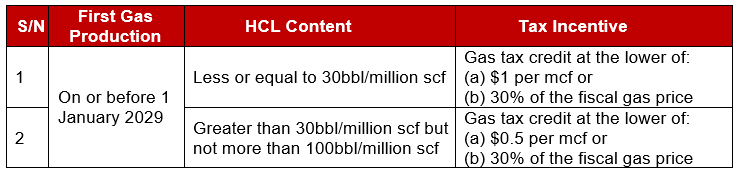
Other non-associated gas greenfield projects with first commercial production after 1st January, 2029 shall be eligible for gas tax allowance at a rate of US$0.50 per thousand scf or 30% of the fiscal gas price, whichever is lower, provided that the hydrocarbon liquids content does not exceed 100 barrels per million scf.
It is important to note that the hydrocarbon liquids content in a non-associated gas field will be determined in a guideline issued by the Nigerian Upstream Petroleum Regulatory Commission (NUPRC).
The gas tax credit shall apply for a maximum of 10 years, after which it shall become a gas tax allowance claimable at the respective rates provided above. The gas tax credit claimable in any year by any company shall not exceed its income tax payable for that year. In addition, such credit shall not be combined with any incentive due from the Associated Gas Framework Agreement (AGFA) for the same non-associated greenfield project.
Any unutilized gas tax credit in any year shall be carried forward to subsequent year. However, such unutilized gas tax credit shall not be carried forward for more than three years.
(b) Gas utilization investment allowance for midstream & downstream companies. which is granted at the rate of 25% on the qualifying capital expenditure (QCE) incurred on plant and equipment with respect to new and ongoing project in the midstream oil and gas industry. The allowance is claimable in the year of purchase of the QCE.
It is important to note that an eligible company shall not be granted the allowance until the expiration of the tax-free period granted under section 39 (1) of the Companies Income Tax Act.
A company will be ineligible to claim this incentive within 5 years from the date the QCE was acquired if:
- the company sells or transfers the QCE to another company that is engaged in a business that is not same or unrelated to that of the seller, or for scrap;
- the QCE is acquired for purposes other than gas utilization; or
- the expenditure on the QCE is not a genuine business transaction or is considered artificial or fictitious.
(c) Fiscal incentives for deep water oil and gas projects, which will be introduced by the Minister of Finance. The objective here is to ensure that investments in the deep water achieve a competitive Internal Rate of Return (‘IRR”).
Reduction of Petroleum Sector Contracting Costs and Timelines, 2024
This executive order introduces timelines aimed at simplifying the approval process for Production Sharing Contracts (PSC) and Joint Operating Agreements (JOA) in Nigeria’s oil and gas industry.
Specifically, the Order covers the following:
(a) Financial Approval Thresholds: The Ministry of Finance Incorporated (MOFI) and the Ministry of Petroleum Incorporated (MOPI) are now directed to take steps to procure NNPC Limited to amend the PSC or JOA to raise the contract approval thresholds to not less than US$ 10 million or the naira equivalent. This threshold shall be reviewed and adjusted by MOFI and MOPI in line with the rate of consumer inflation disclosed by the National Bureau of Statistics on a yearly basis.
(b) Consent Timelines: NNPC Limited and Nigerian Upstream Investment Management Services Limited (“NUIMS”) shall, in collaboration with the Nigerian Content Development and Monitoring Board (NCDMB) and industry stakeholders, simplify the contract approval process and adopt a single level of approval at each contract stage.
NNPCL and NUIMS are obligated to issue necessary approvals within fifteen (15) days from the submission of the application by the relevant party to JOA or PSC. Additionally, NCDMB must approve any Nigerian Content Plan (NCP) within ten (10) days from the applicant’s submission. Where any of the above parastatals does not communicate a decision within the specified timeframe, the application will be considered as approved or consented.
(c) Third-party Contract Duration: Third-party contracts awarded pursuant to a PSC or JOA will now have an extended duration of five years, with the possibility of renewal for an additional two years following the initial five-year period, as opposed to the previous three-year term.
The Order also outlines timelines for document submission and review by the NCDMB, ensuring timely responses and the direction of applications for expatriate quota to relevant government departments.
Local Content Compliance Requirements, 2024
This executive order aims to attract investments and restore economic growth in Nigeria’s oil and gas sector by addressing the misapplication of Nigerian content requirements.
Specifically, the Executive Order mandates the NCDMB to do the following:
- consider the practical challenges posed by insufficient in-country capacity for certain services;
- act in a manner that does not hinder investments or the cost competitiveness of oil and gas projects;
- shall not approve a NCP containing intermediary entities that lack the essential capacity to perform the services;
- approve a NCP comprising contractors that satisfy the legal definition of Nigerian content and show genuine, substantial and tangible capacity to independently undertake projects in Nigeria.
Based on this Executive Order, the NCDMB is to develop guidelines for assessing and verifying the capacity of contractors and modalities for the implementation of the directive.
Implication
The executive orders have the objectives of attracting investments and revitalizing economic growth in Nigeria’s petroleum sector. By addressing challenges related to local content requirements and offering tax incentives, these orders establish a more favourable environment for companies to invest in the petroleum industry.
Furthermore, the orders introduce timelines to simplify the approval process for PSC and JOA, leading to reduced contracting cycle and enhanced decision-making for companies undertaking projects.
Additionally, the orders aim to decrease contracting costs by implementing a single level of approval at each contract stage and setting time limits for approval or consent from relevant entities. This promotes cost efficiency and potentially reduces expenses associated with the contracting process. The emphasis on timely responses from all parties involved in the approval process, through specific timeframes for document submission and review, facilitates efficient decision-making and provides clarity to stakeholders. As a result, the executive orders, combined with other policy directives, seek to improve the investment climate in Nigeria’s petroleum sector. This, in turn, creates opportunities for companies to expand their operations and contribute to the growth of the Petroleum industry.