Why Some Nigerian States Grow IGR and Others Can’t: Infrastructure, Not Enforcement, Is the Difference
January 6, 2026
As Nigeria begins the implementation of the New Tax Law, expectations are high. Policymakers anticipate improved compliance, harmonised taxes, reduced multiplicity of levies, and stronger Internally Generated Revenue (IGR) for states. But there is an inconvenient truth buried beneath the optimism: The
new tax law will not magically fix weak IGR states. It will expose them.
In fact, the reform risks widening the gap between high-performing and low performing states, unless subnational governments urgently align tax reform with infrastructure strategy. The new tax regime will reward states that have built taxable economies, and penalise those that have not.
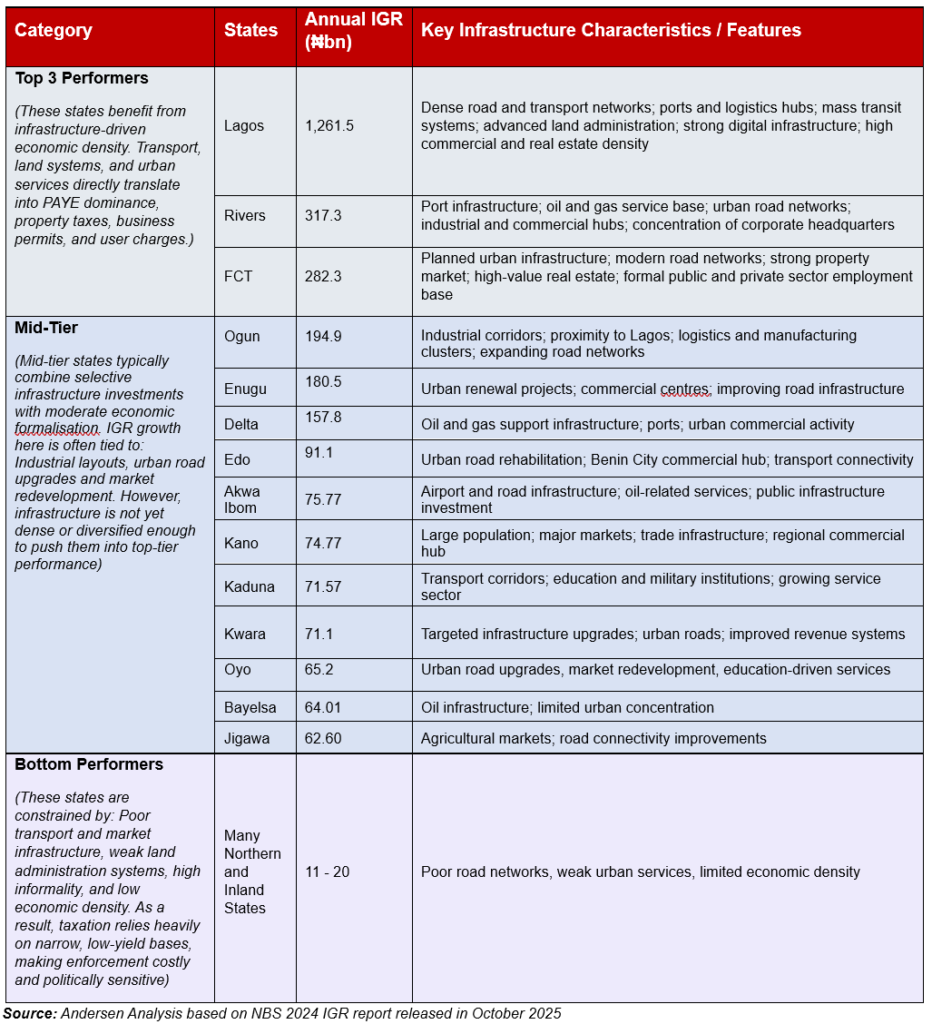
The latest National Bureau of Statistics (NBS) 2024 Subnational IGR report already tells the story. Out of ₦3.65 trillion generated nationwide, Lagos alone accounted for ₦1.26 trillion, while over 20 states generated less than ₦40 billion each. This divergence is not primarily about tax rates or enforcement capacity. It is about economic structure shaped by infrastructure.
Nigeria’s new tax framework rightly aims to simplify taxes, expand the tax net, improve administration, and reduce arbitrary levies that hurt businesses. However, tax laws do not create economic activity; they only formalise and capture what already exists. This is where many states are vulnerable.
States with weak road networks, informal markets, poor land administration, and limited urban services have very little formal economic activity to tax. Under the new regime, where leakages are reduced and exemptions tightened, the ceiling for IGR growth in these states will remain low.
The Infrastructure-IGR Divide: A Snapshot
The NBS data shows three clear clusters:
- Top performers (Lagos, Rivers, FCT): Above ₦200bn
- Mid-tier states (₦60bn–₦199bn): Ogun, Enugu, Delta, Edo, Kano, Oyo, etc.
- Other states (₦10bn–₦59bn): The majority
What separates these clusters is not effort, it is infrastructure-enabled economic
density.
Table 1: Indicative IGR Performance by Nigerian States
Why Infrastructure Does the Heavy Lifting
Infrastructure grows IGR through four powerful channels that policy debates often
ignore. Below are the channels:
- It expands the economic base: Roads, transport corridors, and logistics infrastructure reduce transaction costs and increase business density. More businesses mean more PAYE, business premises levies, transport fees, and consumption-related taxes. Where movement is difficult, economic activity and taxation remain limited.
- It unlocks land and property revenues: The IMF estimates that Nigerian states capture only a fraction of potential property tax revenues. The reason is simple: property taxes only work where infrastructure creates value. Drainage, access roads, and urban services raise valuations; infrastructure neglect destroys them.
- It drives formalisation: Organised markets, industrial parks, and serviced commercial zones pull businesses out of informality. Formalisation is not forced by enforcement; it is incentivised by infrastructure. Once formalised, businesses become visible, bankable, and taxable.
- It improves tax morale: World Bank and IMF studies consistently show that visible service delivery increases voluntary compliance. Citizens are more willing to pay when they can see where